
The One Game I Can't Stop Playing
My review of Hearts of Iron 4, 2000 hours later

For the past 5 years, at least once a week and often more, I’ve been settling in at my desk, beverage in hand and snacks at the ready to alter the course of history for the better, the worse or the just plain weird.
Hearts of Iron 4 has achieved a level of success other strategy games only dream of. After just under a decade on the market, its concurrent player count is still growing and generally hits a new peak after each expansion, it consistently sits in the top-30 most-played games on Steam, possesses an enormous modding scene and has a healthy sphere of YouTubers who often spur interest in Paradox Interactive’s other games too.
I’ve been playing Paradox games since 2016 and have several thousand hours across their pantheon of titles, I’ve done everything from defeating Nazi Germany and the Soviet Union as Poland, to founding an Aztec Empire in the highlands of Mexico and everything in between; this is a developer and a set of games I care a lot about and have put loads of time into. This review will be written with all the depth and care such a towering pillar of the strategy genre requires… which is why those who follow the Journal will know this has been several months in the works.
Hearts of Iron 4 is my most-played game on Steam, my most hated game on Steam, my most loved game on Steam, my greatest gaming addiction and the source of my most bitter rage quits and most boast-able triumphs.
I hope you enjoy.
A Clean Fight
On booting up Hearts of Iron 4 you will be greeted with all the hallmarks of popular Second World War media: pithy loading screen quotes from some of the most famous and infamous figures of the war, pieces of art depicting scenes of combat or occupation on the various fronts of the conflict and all underscored by your typical reverent orchestral notes. It’s a pleasant, if romanticised whetting of the palate for what was really the most horrific episode in mankind’s long-history and the in-game music player over time has been bulked out with everything from Sabaton to the Red Army Choir.
This sanitisation of the war and historical events by Paradox has raised eyebrows often, which I will get into later.
Hearts of Iron 4, first and foremost is a war game. While Paradox’s other titles focus on economics or managing an empire, Hearts of Iron 4 is entirely concerned with the player stabilising their nation in the volatile geopolitical landscape of the mid-20th century, creating and equipping their military and aligning themselves with one of the 3 major factions of the Second World War, or creating their own bloc of nations in order to survive. ‘Any alliance whose purpose is not the intention to wage war is senseless and useless.’ The loading screen states and it’s a philosophy Paradox took to heart.
That was also a quote from Adolf Hitler, so now I’m cancelled.
There are many exceptions, such as the beleaguered Republic of China, which is invaded in 1937 by Japan and the chaotic Spain which breaks out into civil war in 1936 but in general, a game of HOI4 has 3 distinct phases: the early game from 1936 to 1939 sees the player build up their industry, edit their unit templates and take the appropriate steps in order to join a faction, stabilise the country or switch their political ideology. From 1940-1943 you have the early war where most nations are still relying on infantry and cavalry, the major players aren’t quite all-in yet and a lot of the doctrine and tactics haven’t fully materialised. Finally, from 1943-1946 you have the late-war going into the post-game, this is the time where most of the research has been done, factions have solidified and fighting is taking place on every part of the globe but it starts to become clear who will win and who will lose.
The basic building blocks of Hearts of Iron 4 are generally very solid, however, there are some critical issues which have plagued the game since its launch. Firstly, the faction system can be infuriating.
The system is tied to a mechanic called ‘World Tension’ which, to cut a long story short, ensures that the more conflict there is in the world, the easier it is to join factions and get in on the action, with all restrictions more or less off the table at 100% tension (which tends to be reached once Germany invades the Soviet Union.) This lack of restriction means that you can end up with some truly bizarre members of a faction joining, usually to screw the player over, as the AI favours targeting you above other CPU countries. I cannot count the amount of times I’ve been completely mugged by this. I once was playing as Maoist China and had the Republic of China join the same faction as the Soviet Union when I attacked, meaning that my communist revolution was being stamped out by the head communist state itself. Another time, I watched World War 2 begin when Lithuania was invited to the same faction as Japan in its fight against a Polish invasion. You cannot make this shit up.
Hearts of Iron IV has a historical and ahistorical setting but the CPU can still go badly off-script if the player really messes up history, which is both a blessing and a curse.
A second big issue with Hearts of Iron 4 is that the AI is often just plain useless and certain hard-coded behaviours make entire strategies completely unplayable. An infamous one is playing historical, Western-aligned Poland. In real life, Poland took about a month to fall to Germany and naval routes to the country were infested by German submarines, so France and Britain didn’t really have the time or means to provide assistance, as a result… the AI is hard-coded to not send forces to assist. This can be a hair-pullingly irritating bit of behaviour as advanced players will likely be able to hold out as Poland, at least in the defensible central regions but will find themselves being given zero help, even when the naval war is in-favour and Germany is vulnerable. This also extends to the AI’s overall force allocation and army composition; it took until last year for the British CPU to be tweaked so it garrisons an appropriate number of troops to defend its own soil.
Hearts of Iron 4 started life as a World War 2 simulator: the major and minor powers of the war had playable content but mostly focused on fighting for one of the major factions and a few what-if scenarios but over time, Hearts of Iron 4 has shifted focus to become a World War 2 sandbox experience; even Afghanistan has its own content now. The trouble with this is that over the years, historical accuracy, plausibility and game balance have taken massive hits.
Of all the nations in the game, which do you think is probably the strongest? You might pick the canonical victors of the war: the USA and the Soviet Union, or perhaps Germany for the speed with which they conquered most of Europe… the most powerful countries in the game, in the hands of a good player, are Argentina and Finland: a country that had only a tertiary role in the war and a country that was defeated by the Soviet Union before its allies. The change in focus has also led to the older content feeling really half-baked and to some countries being really underpowered, the worst of which is probably Japan but France is quite crap as well.
The weakest Finnish infantry
Did we really need a DLC that added the ability to revive the Mughal Empire in India when Japan and the Pacific theatre are generally considered to be outdated and not fit for play?
To cap off this section, I wanted to mention Paradox Interactive’s policy of not depicting or acknowledging atrocities and how I believe it helps fuel a serious problem.
The community of this game, unfortunately, has garnered a reputation for harbouring ultra-nationalists and other extremists. This goes beyond edgy teenagers playing as Nazi Germany and throwing up a suggestive comment in the forums, pretty easily, you can find pro-Fascist fan fiction on the Steam Workshop, players sporting flags and maps of territorial claims of fascist powers and earlier this year, a huge number of Chinese nationalists began to bombard the studio with death threats and review bombed the game. When you play Hearts of Iron 4, you put yourself into the shoes of a nation in wartime and from these expansionist perspectives, with all the nasty stuff removed, it all seems quite honourable and sympathetic: Germany wanted to re-occupy its former territories in Poland but the nasty imperialist France and Britain said no, Hungary was reduced to a tiny state and just wanted their old lands back, the Allies never attacked neutral nations or committed any crimes, they were just there to help!
It’s all a sanitised, palatable lie.
I’ve been to Auschwitz, I’ve met communities of people in my time that began with the displacement and chaos of the Second World War, I completely understand not allowing the player to perpetrate these crimes but by refusing to even acknowledge events like the Katyn Massacre, the Rape of Nanking, the bombing of Dresden or the Holocaust, Paradox Interactive oversimplifies some of history’s worst events, and in turn: mankind’s darkest chapter, into a simple land dispute between blocs of allied states.
When you play this game for a long time, it’s easy to just see the likes of Nazi Germany, Fascist Italy or the Empire of Japan as Megatron, Starscream and Soundwave: villains of the week who you love to hate and always enjoy seeing get their comeuppance each session but every now and then, it’s a good idea to remind yourself of what these people actually did.
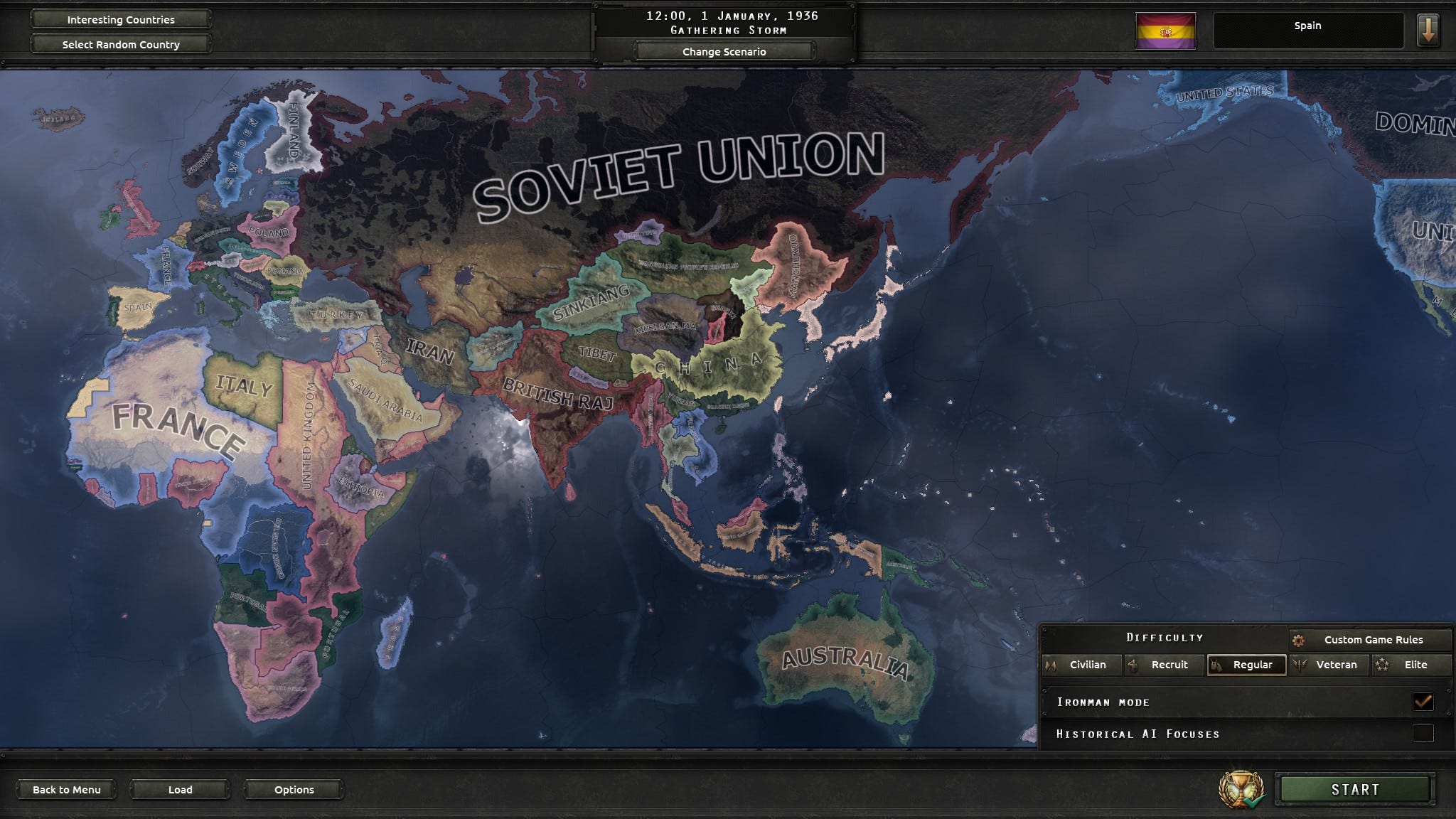
Cash Alone Moves the Wheels of History
As much as Paradox interactive have delivered some fantastic strategy games, especially between 2012-2016 it’s impossible to discuss this company and their products without mentioning DLC.
To cut a long story short, Paradox Interactive doesn’t make sequels often and prefers to keep their games afloat with years of DLC and updates, the trouble with this is that games like Hearts of Iron IV and Stellaris are nearing 10 years old, so those looking to get into the game, unless they wait for a sale, are looking at forking over something in the realm of £150-225 to get their games to the same level of content as the existing fanbase.
But Paradox has a solution: the Hearts of Iron 4 DLC Subscription, where you can pay a small monthly fee of £6.69 and have access to all current and future DLC with the option to cancel anytime. This sounds like a good deal on paper but again, it’s another subscription and yet another case of the consumer’s right to ownership being eroded when they could have just put this stuff in an ultimate edition of the game and sell that with a much more reasonable price tag; vanilla HOI4 is £41.99 as of writing: way below Triple-A pricing standards, I think a lot of people would rather pay £80 and own all the DLC than get hooked on a subscription.
Another solution, which Paradox seem to be exploring, is to fold outdated DLC into the vanilla Hearts of Iron 4 game. Some of the earliest, most fundamental DLC: Together for Victory, Death or Dishonour and Waking the Tiger have been added into that vanilla package but this hasn’t gone far enough in my opinion, DLC like No Step Back and By Blood Alone are several years old at this point and are fundamental to the modern experience.
I have to say though, in a post-No Man’s Sky world, where so many other great games offer unctuous free content updates this all feels very twee, especially as the prices of these DLC have gone up over time and the quality has only gone down. The most recent DLC: Graveyard of Empires was absolutely dreadful and put me off the game for a solid 2-3 months.
Si Vis Pacem Para Bellum
As I said before, Hearts of Iron 4 is a war game, therefore its combat is the star attraction.
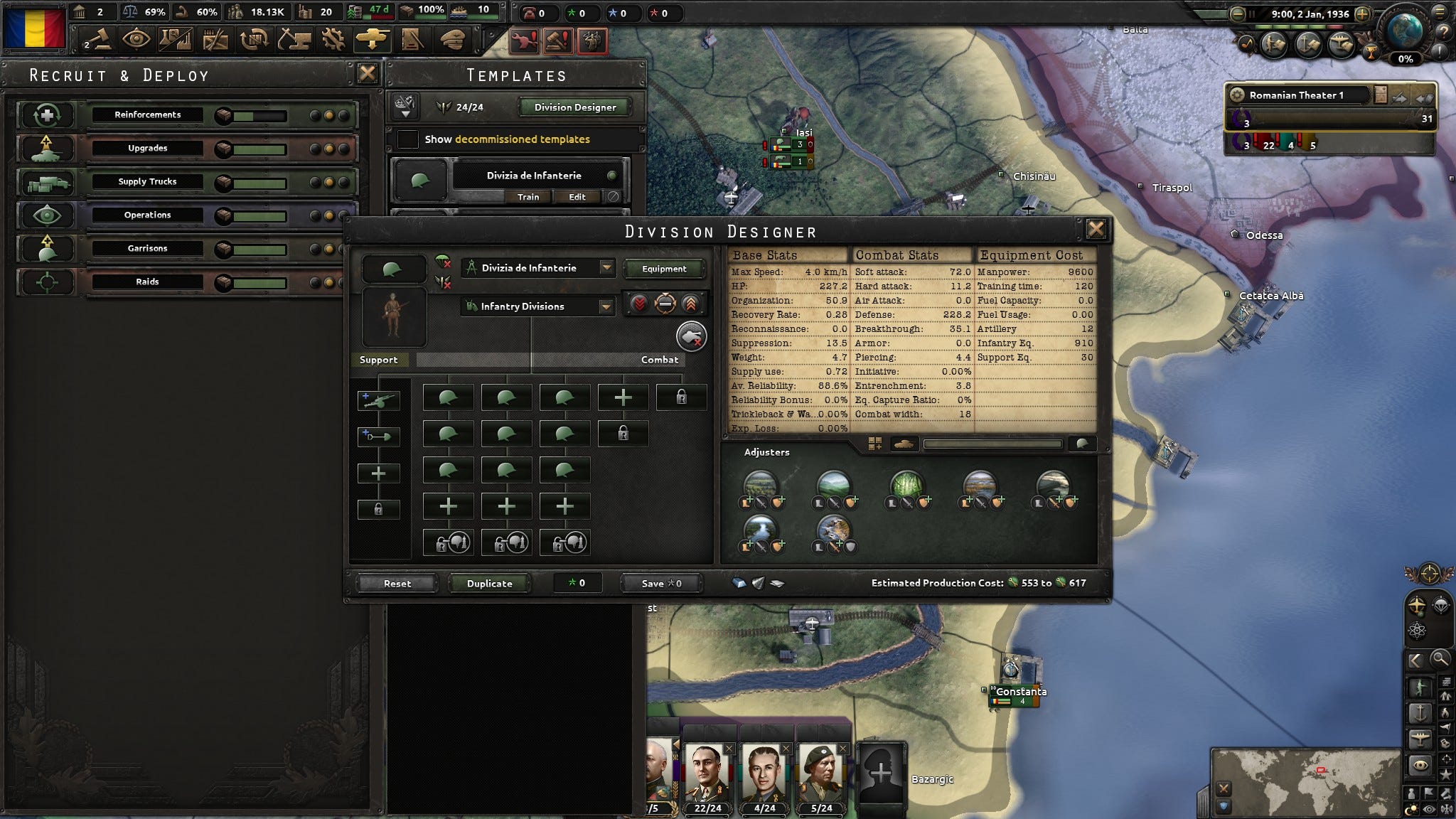
Hearts of Iron 4 ground combat: the backbone of the game, is a stats-based, terrain-influenced system that uses a combat width mechanic to simulate the amount of troops in your fully customisable divisions that can fight on the frontline in a battle at any one time, units exceeding the combat width are put in reserve where they replace those who can no longer fight; a division’s health is measured in organisation and equipment, if the organisation bar is depleted it can no longer fight, if the equipment bar is depleted it will begin to take massive morale damage, if both are empty then the division is destroyed, this is quite hard to accomplish in a straight fight and typically requires a full encirclement.
Armies are controlled by using the frontline tool which the player uses to create a frontline bordering enemy territory and then draw a rough direction for an assault but it also has options for area defence where you can garrison troops across large amounts of territory with an opt in, opt out system for securing certain points of interest like logistics hubs and you can place fallback lines, which instructs your army to dig in and hold a line you draw with your mouse; there are also options here for naval landings, how far away you want reinforcing divisions to be drawn from and much, much more. You can set a frontline and free-wheel offensive operations yourself and many advanced players do, especially in PvP but if you’re playing anyone larger than a Balkan state, the micro-management gets a bit much.
This all sounds simple so far but every single terrain type in HOI4 has different maluses and bonuses, different combat widths, supply requirements and every battalion you can place in your division has an effect on the division’s stats and this is why I have 2000 hours in HOI4: there are a million different ways to build your army, a rainbow of different stats to ponder and a million different ways to achieve one objective. What works in the Amazon won’t work in the Swiss Alps, what works there would never work on the Eastern Front and what works in Russia won’t work in China. If I fully explained how it all works I’d be here all day but rest-assured you can create an army of any size, shape or doctrine and make it work if you’ve got the lobes for krieg.
You’re facing a wall of enemy bunker tiles, each stacked with infantry. What do you do? 5 Players might pick 5 completely different solutions.
Player 1 might gain air superiority and use strategic bombing to destroy the bunkers and enemy logistics to render the infantry undefended and undersupplied, Player 2 might mass heavy tank divisions to relentlessly attack a single tile until they break through, forcing the rest of the defensive line to reposition and lose their entrenched buffs, Player 3 might pull back from the line and bait out the enemy to follow before encircling their advancing forces with fast-moving motorized divisions, Player 4 might grind down the enemy’s lines with relentless infantry and artillery attacks, leveraging their larger numbers and industrial might while Player 5 might avoid the bunkers altogether and stage an amphibious landing somewhere down the enemy’s coast. I cannot stress the freedom and depth of combat in this game, I absolutely love it and boot up a save sometimes if I have a wacky idea for a new division template; this is one of those strategy games you think about when you’re not playing, mulling over your latest loss or how you can counter AI Stalin slamming your lines with 9 heavy tank divisions.
The game further encourages distinct playstyles by forcing you to pick between a doctrine type for each theatre of war, the land doctrine is most important and has you pick between:
Mobile Warfare: a focus on high-speed mechanised divisions and tanks, akin to the real life Wehrmacht.
Superior Firepower: a focus on offensively leaning infantry with support companies, artillery and preserving manpower, akin to the real life US Army in WW2.
Grand Battleplan: an infantry-centric doctrine that focuses on deep entrenchment for high defence and extensive planning bonuses akin to the British Army in World War 2 but generally clings to older WW1 doctrines a bit more closely.
Mass Mobilisation: a doctrine that provides bonuses for armoured warfare across long frontlines, reduces the equipment consumption of your divisions and allows you to fit extra battalions inside for more firepower, much like the Red Army but definitely with elements of German doctrine too.
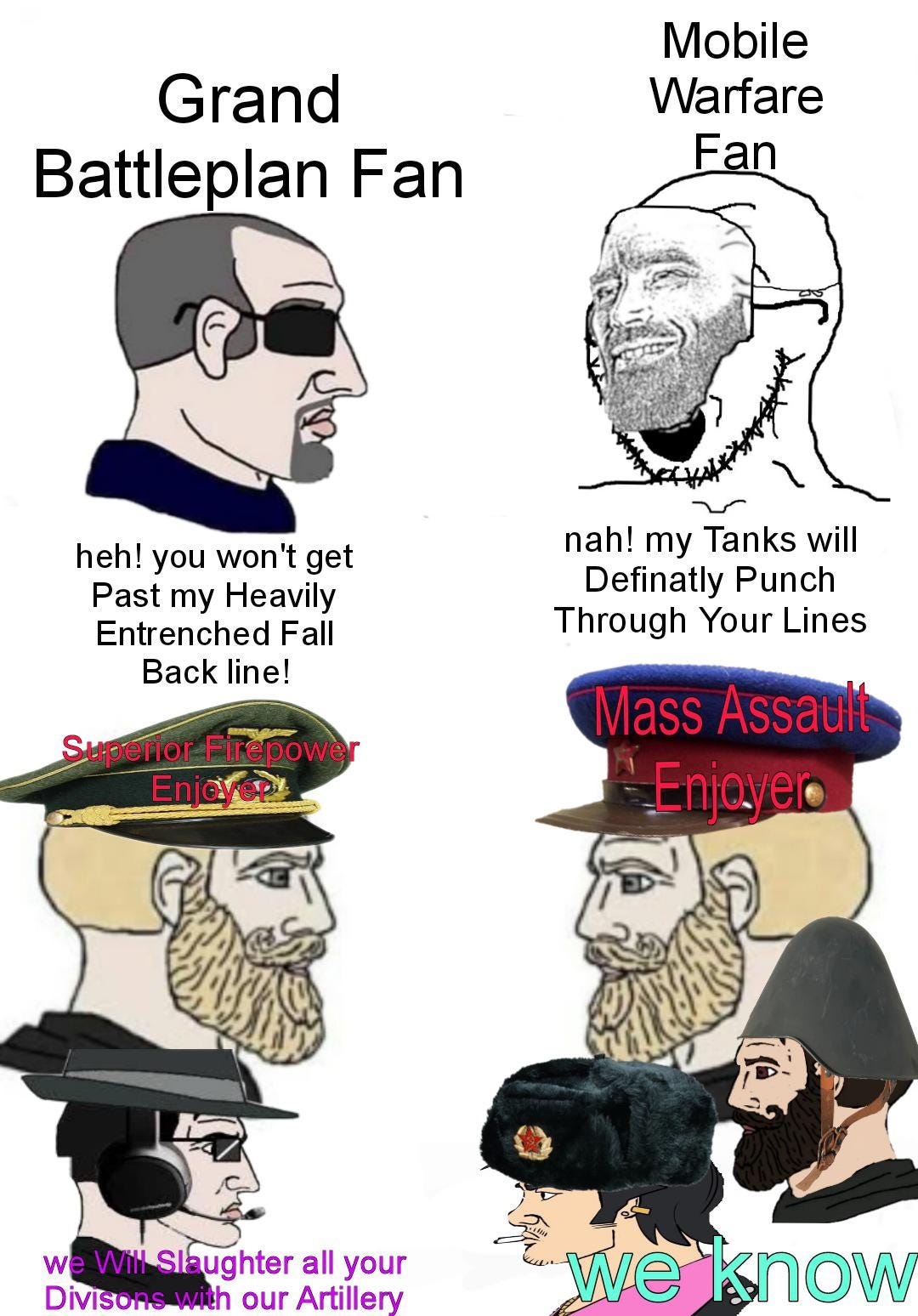
My favourite of the bunch is Superior Firepower but I have been known to indulge in Grand Battleplan when I’m feeling frisky but obviously, you’ll want to pick Mass Mobilisation for the USSR or China and Mobile Warfare for the likes of Germany and maybe the Axis Minor Powers, if you can borrow some hand me down Panzers from Big Bad.
Air combat and naval combat are a bit more of a mixed bag due to a combination of poor balance and some absolutely horrific UI design.
In the case of air, defending your airspace is absolutely trivialised by overpowered radar and AA emplacements. If you have only 200 fighters against 1000 then with good quality anti-air emplacements and radar you will absolutely shred the enemy’s air force; this is partially based on real life where, with drastically fewer numbers but with advanced radar technology and better pilot survivability, the British RAF decisively defeated the German Luftwaffe in the Battle of Britain but it does feel too easy in HOI4.
On top of this, CAS (Close Air Support, also known as Dive Bomber) planes are notoriously overpowered, if you have built an excellent design and have enough of them with air superiority, CAS can make the enemy’s ground army drastically weaker and provide potent bonuses to your own. Again, German close air support was fearsome in World War 2 and the Soviet IL-2 Shturmovik gained infamy for its effectiveness and has even been accredited by some sources with destroying a whole German tank division at one point but again… if it was this easy, 27 million Soviet citizens wouldn’t have died in WW2.
Navy in Hearts of Iron 4 is so unenjoyable and opaque that it’s a long standing meme in the community.
I can play navy at an average level of proficiency and generally know what I should be doing but to this day I still have to have to Google how to do basic actions like base fleets in different ports and merge groups of ships together because the user interface is totally, unconscionably dreadful. A bigger issue though is that thanks to naval research taking so long and large ships often taking 2-3 years to build (in a game that usually concludes in 8-10) the overwhelming majority of nations don’t get much use from building a single large vessel, let alone a chance to field a fully-functional navy; just like real life, it was the major powers: particularly the Western ones and Japan who were the heavyweights of the naval war so most players not only don’t know how to play navy but never get the chance to learn either.
Balance issues rear their ugly head again too because submarines rule the waves. To be fair, Paradox have taken steps over the past few years to drastically reduce the potency of submarines but the simple fact that they are often quick to build and can’t be countered by vessels that haven’t been designed with the necessary weapons to do so makes them the best option at all times; anti air and torpedoes, if you are designing/retrofitting naval vassals in HOI4 you need to remember these 2 things, otherwise you’re not leaving your own shores. Of course, another big knock against navy (with a touch of my own personal bias here) is that the air force can often do the navy’s job but better; if you play as Germany for example, it’s better to spare your navy the horrors of the British Fleet and simply spam torpedo bombers and strategically bomb their ports in the channel, if you dominate them badly enough you can land paratroopers on Blighty herself and capture yourself a port in which to land the rest of the army.
Back to my praise now and I just love the vehicle designers in Hearts of Iron 4, it adds an even deeper layer to this whole thing.
Every single tank, plane and vessel in Hearts of Iron 4 (apart from a few pre-set models and logistics vehicles like transport planes and convoys) are designed from the ground up by the player: want to design a light fighter plane with a nasty pair of cannons and a high-powered engine? You can do that. Want a destroyer with nothing but anti-air flak? You can do that. Want to make a tank destroyer with no armour? What a weirdo! The ships are probably the most complex but you won’t use navy, you might say you will now but you won't.
Stringing your entire war effort together is the supply system, not to be confused with, but closely related to your division’s orange equipment bar. Supply is the single most important mechanic to understand when waging war in Hearts of Iron 4, your supply level governs how easily replacement equipment and recruits can be brought your divisions, having low supply ravages your divisions with heavy maluses and as equipment level is directly tied to morale: essentially the health bar, engaging in combat with horrible supply stands a real chance of destroying your troops if you’re not careful; this is primarily the way encirclements destroy divisions too, because all supply is cut off meaning very quickly they are taking direct morale damage.
Unfortunately, there is one huge, beeping-booping, processing elephant in the room that makes all of this much less fun than it could be and that’s the AI, yet again.
I mentioned before that they can be really stupid and certain hard-coded behaviours make playing different focus trees infuriating, well this extends into the gameplay as well. Whether the AI cheats in Hearts of Iron 4 is something that has been debated a lot in the years since it launched; to be clear, it doesn’t have any specific, blatant cheats present in the code but there are a few things the CPU seems to be capable of that will really piss you off sometimes.
Firstly, it sometimes feels as if the AI gets to completely ignore the supply system and cheat. You can find numerous examples of this online and while it is true that every tile in the game has an ambient level of supply, when you’ve surrounded an AI division, placed it under constant siege and it still won’t break? That’s when you call BS.
A second issue that rears its ugly head is the AI’s love of spam and this complaint has 2 layers. On one hand the AI loves to spam these Command Abilities. Now, if this game’s combat system wasn’t complicated enough, every general and field marshal has a skill tree that they level up depending on the types of divisions they command, for example you might send one general to fight in Libya with mechanised troops and light tanks, this will lead to that general gaining abilities like ‘Desert Fox’ or ‘Combined Arms.’ This also grants abilities like Force Attack or Last Stand the player and AI can toggle during combat and the trouble here is that it just mashes these buttons and never seems to have any limit or cooldown on them, so irritating.
The second way the AI loves to spam is by producing an absolute sea of poor quality divisions and this is bad news no matter whether you’re facing them or fighting alongside them. On one hand, as their ally, your frontlines are often swamped with excess divisions you couldn’t possibly supply and this can potentially ruin your advance into enemy territory and produce extra casualties you wouldn’t have suffered otherwise, this is particularly annoying if you’re using mechanized and tank templates that guzzle a lot of fuel, heavy tanks are not cheap in this game and it’s always a serious pain to watch them getting reduced to scrap metal. When in offense, the spam means the AI ruin their own supply lines often making them quite easy to defeat, their brainless mashing of command abilities usually depletes all their offensive divisions and it’s not uncommon to see them flying hundreds of planes over Greece when the skies over Russia are hotly contested and in-need of reinforcements.
I can’t stress this enough to those looking to get into HOI4, unless you’re playing as a nation particularly well-suited to fielding gargantuan slop armies like the USA, the Soviet Union or China, less is almost always more; a fully supplied, well-designed 24 width division will almost certainly smash through 3, 12 width divisions with supply issues and the same goes on the defence.
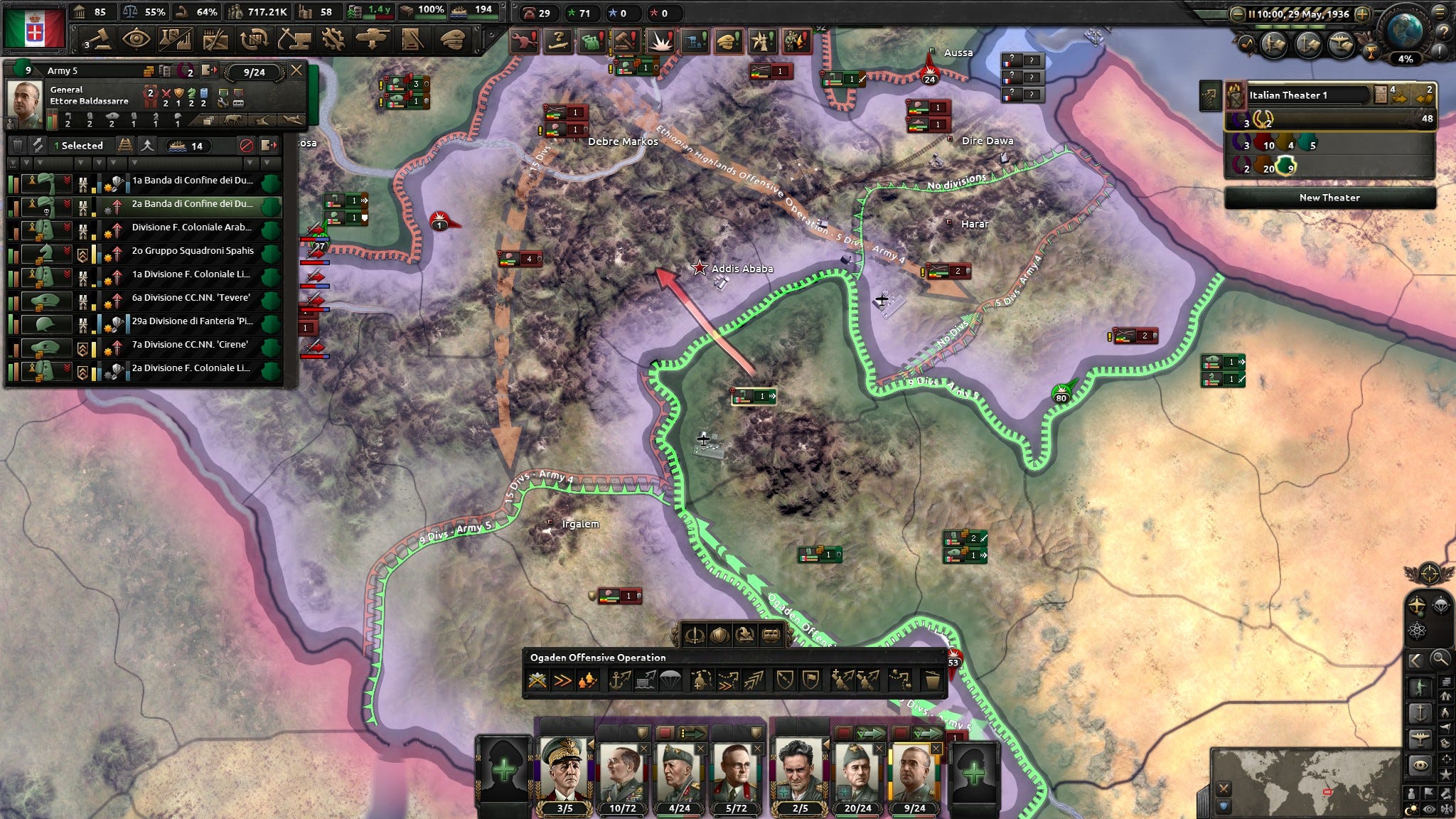
AI Ethiopia left its capital completely undefended.
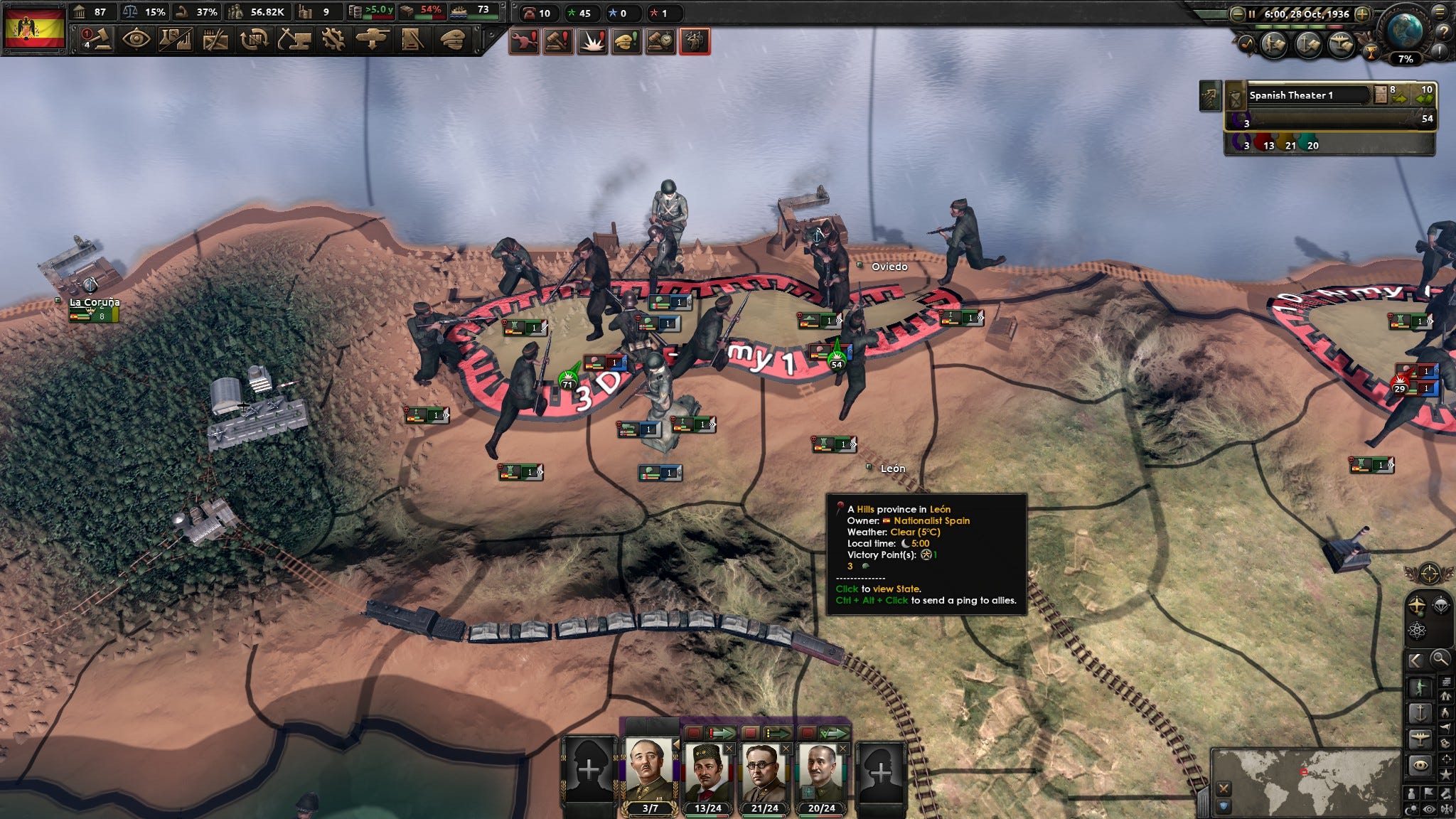
2 Enemy divisions that somehow maintain supply on a mountain, fully encircled, with enemy air superiority while under constant attack.
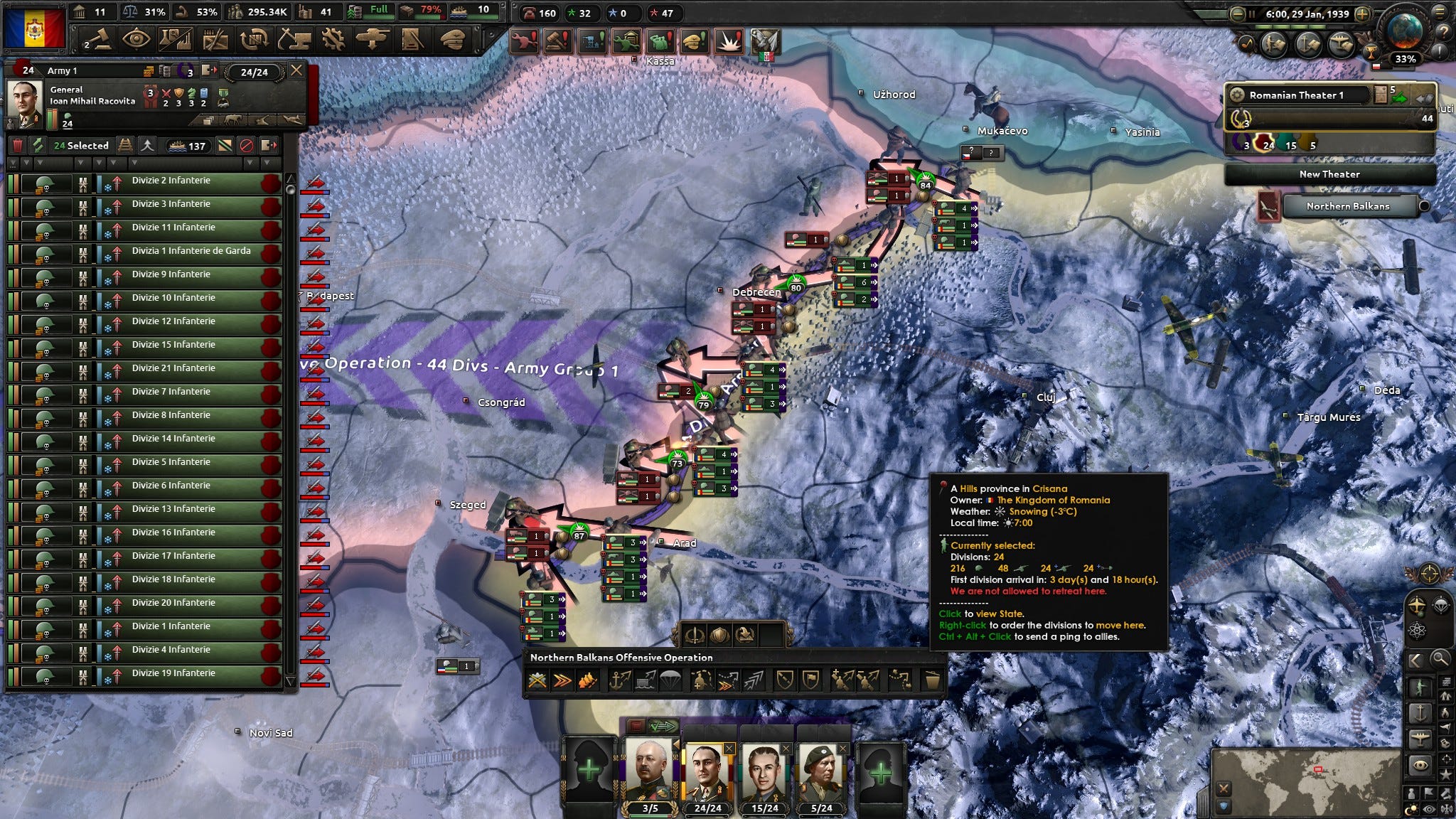
The enemy AI spamming the ‘Last Stand’ ability, this continued until their divisions started to be destroyed.
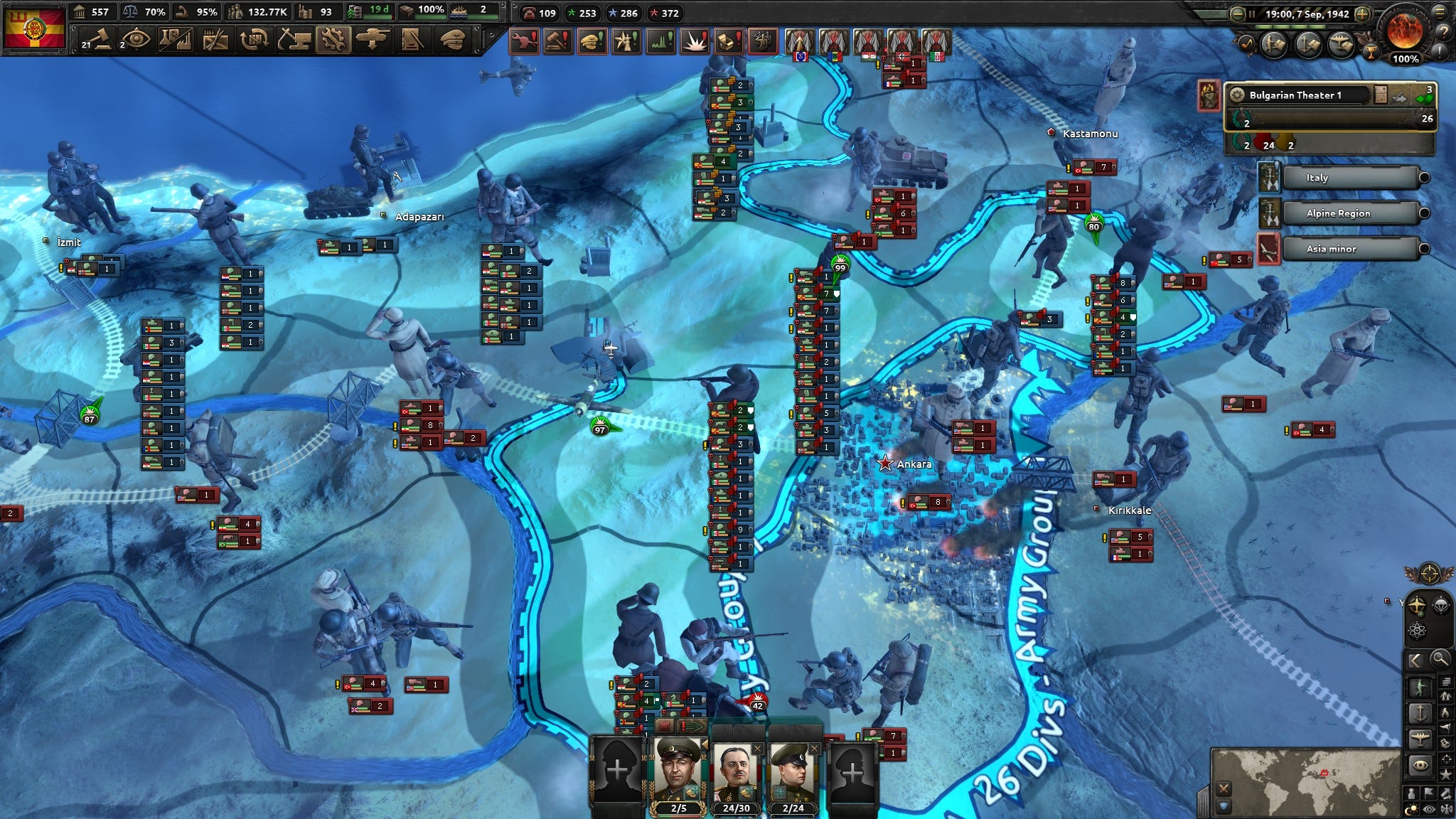
My invasion of Turkey being utterly ruined by the AI (blue) filling my mountainous frontlines with an absolutely stupid amount of troops and armour.
There is one cheat that exists in every Paradox game and is also 100% present in Hearts of Iron 4 that the AI possesses: zero fog of war. This doesn’t really present any issues since the CPU is programmed in such a way where this doesn’t become frustrating, just something worth mentioning.
Live In Infamy
As great as combat is in Hearts of Iron 4, it’s often the Focus Tree and political system that takes up most of the player’s time in the first half of the game and these focuses determine whether a nation is fun to play or not.
The previous game in the series Hearts of Iron 3 suffered from a mind-numbingly boring build-up to the war that involved a convoluted system with a neutrality scale an ideology triangle and other elements the player had to juggle while industrialising and sculpting their army, to get around this and to make the game much more accessible, Paradox introduced the national focus tree: a kind of political tech tree that grants factories, war goals, ideology support and many more bonuses, usually in alignment with a real or alternate historical narrative.
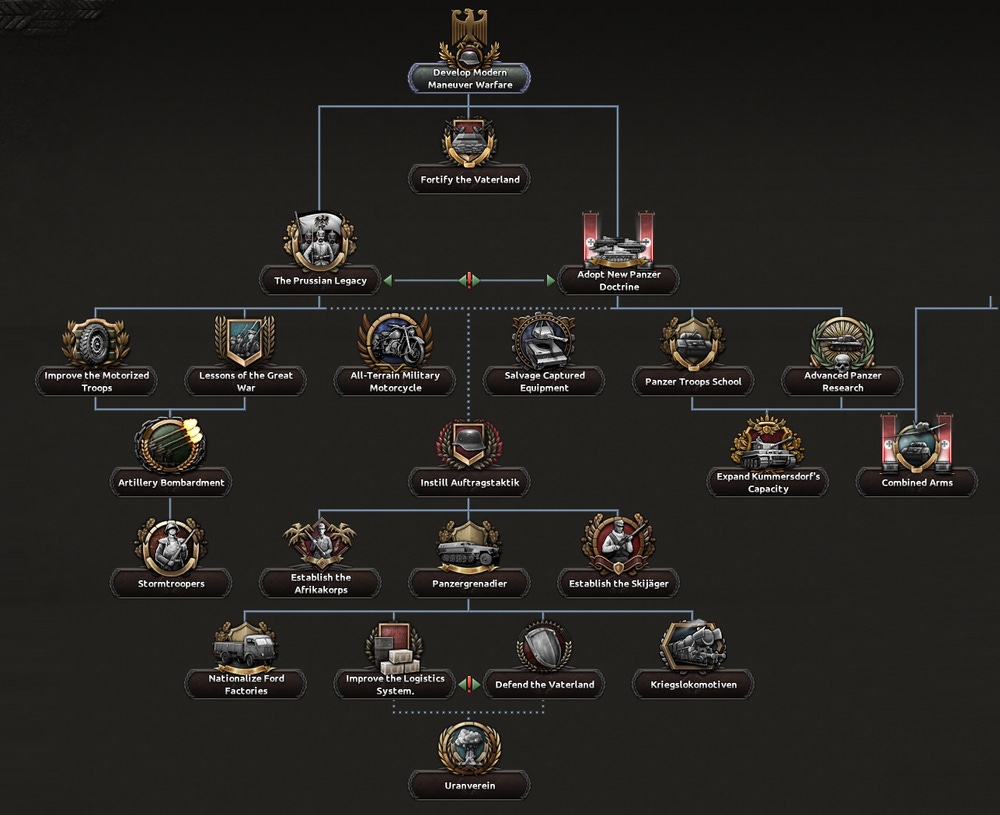
Part of the German focus tree, there are usually several branches of a focus tree, this one is the army branch and grants extra doctrine research, tank designs and various bonuses and generals.
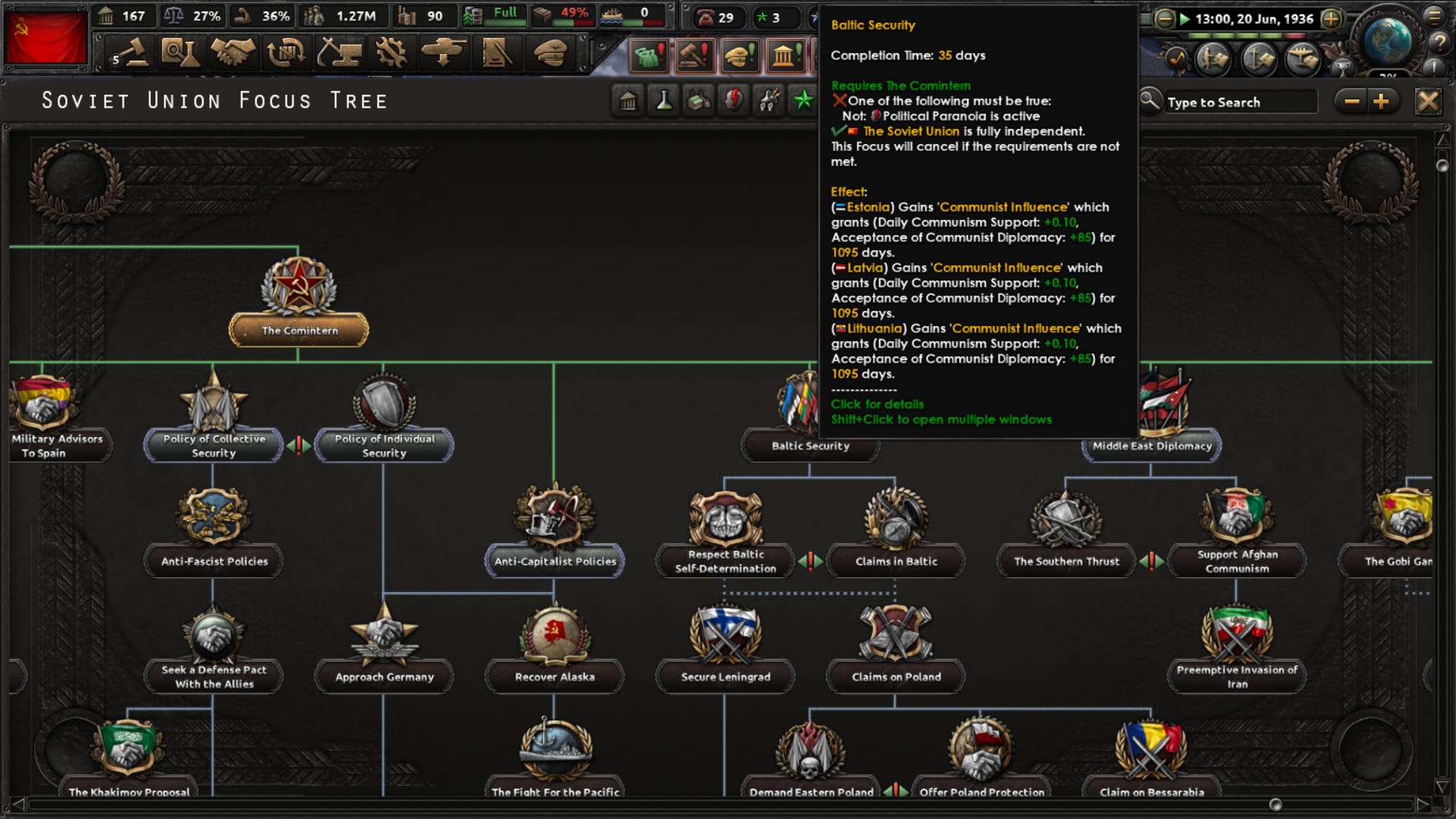
A slice of the Soviet Union’s political branch of the focus tree, here you can see freebies like war goals and communist support in neighbouring countries.
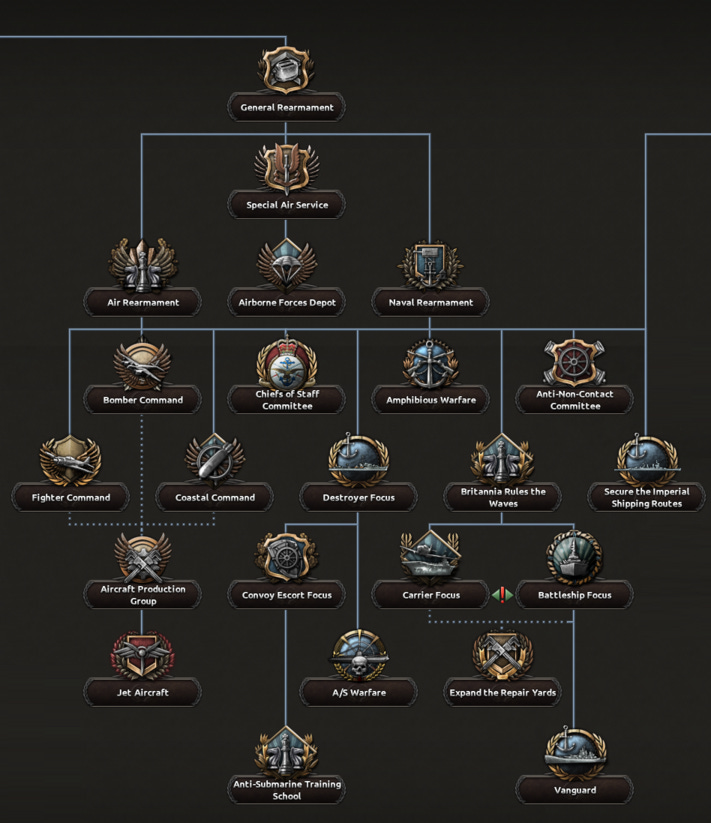
Part of the British focus tree, this time from the industry and shared air-naval branch.
I hope this look at some different focus trees shows the variety on offer, unfortunately the same can’t be said for all of them. I mentioned before that some nations were outdated or overpowered and it’s in focus trees that you find this. Updated nations like Germany, Poland and Italy can get several factories from a 35 day long focus or sweeping advantages from a standard 70 day long one, whereas very old focus trees like Australia’s will give you a single railway around Darwin for the same wait.
I know I have a few readers from Australia and New Zealand, your countries have the worst focus trees in Hearts of Iron 4, my deepest sympathies.
On the other end of the spectrum you have the likes of Finland that get some stupidly powerful focuses so the player can survive the USSR, focuses that grant you absurd equipment capture rate, essentially allowing you to equip your army just by inflicting casualties on the enemy and hyper overpowered support units that make your army practically immortal in arctic warfare. Seriously, I’ve beaten Nazi Germany handily as Finland before, it’s ridiculous.
In tandem with the focus tree, you are able to swap out military advisors, warfare experts, political advisors, change economic laws and heads of the different branches of the military, all of which should ideally be done in the pre-war phase of the game.
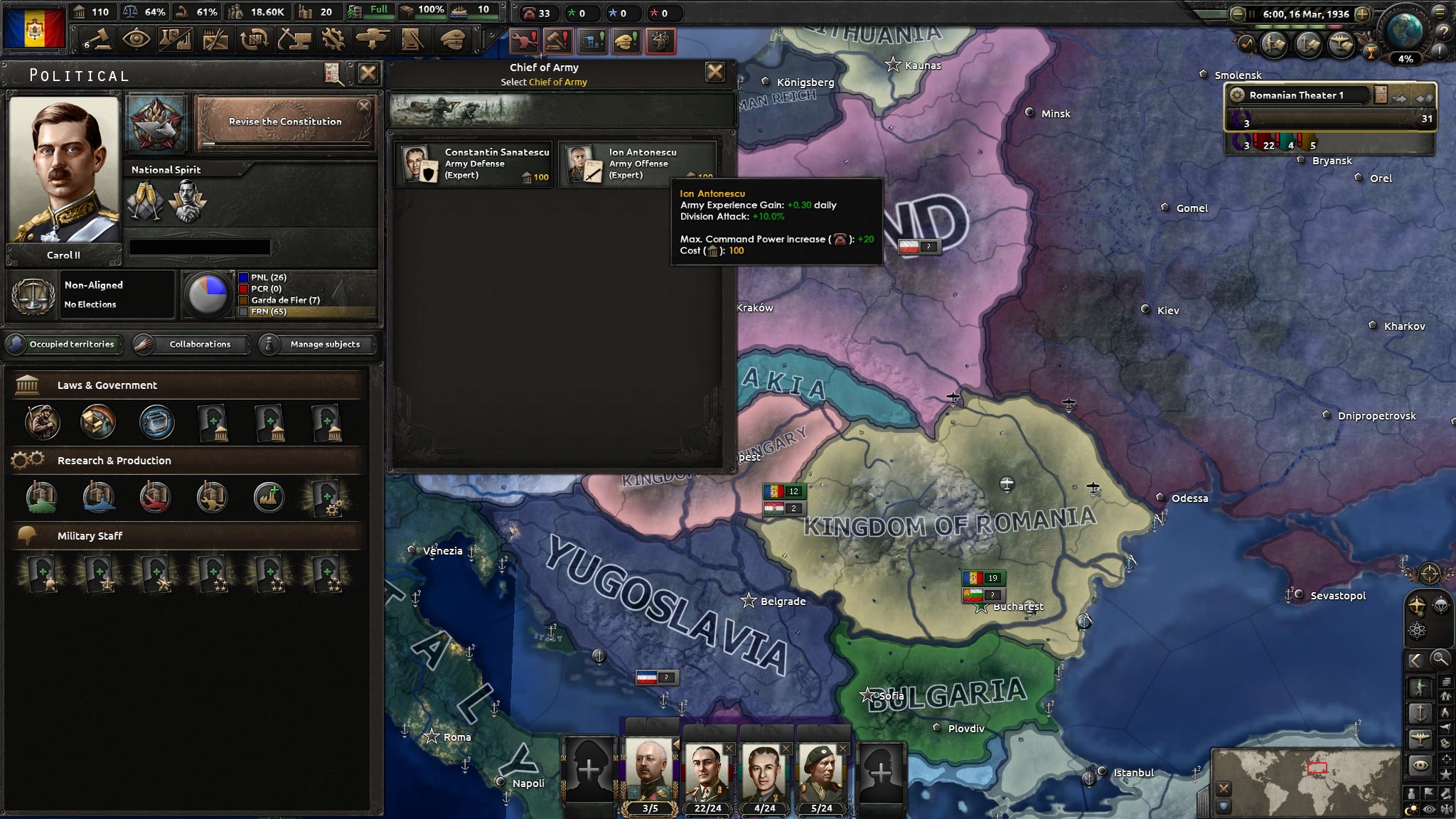
The political system in Hearts of Iron 4 hasn’t really changed much since launch and barely at all in the 5 years I’ve been playing the game, some argue it needs a new coat of paint and more options but in my opinion, it’s best left as it is; Hearts of Iron 4 excels when you’re as deep into the front management and industrial strategy as possible and it already has a lot of mechanics that don’t blend into the gameplay loop particularly smoothly or feel like bloat, like the Espionage System and Special Projects (read as: Superweapons) so I’m happy to not have to divert my attention away from the frontline for deeper mechanics in this area. All of that being said, and this is another problem caused by the tilt towards sandbox gameplay, a lot of focus trees and the game's narrow political wheel of 4 ideology groups tends to badly misrepresent some historical figures or imply that people from the same ideology group across borders would naturally get along.
One example is Oswald Moseley. Moseley led the British Union of Fascists and his ideology was marked by many of the common Fascist ideas at the time like autarky, corporatism and antisemitism but where Moseley differed from the other revanchist Fascist minds of Europe is in an opposition to war; it was obvious by the mid-1930’s that Britain would once again cross swords with Germany and Moseley wanted nothing to do with it… except his focus tree allows you to do exactly that and attack much of Europe too.
There are numerous other examples too like historically separatist Flemish figures becoming rulers of a united Fascist Belgium, or Communist governments made up of people who were barely communist but you get the idea.
An element I would like to see overhauled some day are the lend-lease and trade systems. In real life, several theatres of the war were opened with the explicit intent to make the acquisition of resources and flow of lend-lease easier, two examples are the Anglo-Soviet Invasion of Iran, which allowed Allied lend-lease to flow into the Soviet Union more easily, or the Nazi Invasions of Norway and Denmark, which was primarily done to create a choke hold on the Baltic Sea and facilitate easy transfer of Swedish iron ore. The current system is quite shallow and the AI is infamous for cancelling lend-lease agreements for no reason or for offering you absolute pittance; I distinctly remember being offered a single M1 Garand a month once and it caused me to burst out laughing.
Trade in Hearts of Iron 4 is very basic, the player can assign Civilian Factories to either import equipment from the international market: another bloat feature that nobody competent at industry will ever use, or to import natural resources like Steel, Oil, Tungsten etc. with each one playing a role in manufacturing different types of equipment; aluminium and rubber for example are the 2 main resources needed for planes, but rubber is also used in production of trucks. Of them all? Steel and Oil are the most important with the former being used in basically everything and the latter being what anything with an engine requires to run. Your economic laws govern how much you can import and how fast you can build while harming your security; Free Trade provides every Tom, Dick and Harry with intel about your country but provides huge construction and output bonuses, with a Closed Economy being the other way around.
By So Many To So Few
So far this has been why I love Hearts of Iron 4, despite its shortcomings but before I wrap this review up I want to highlight this game’s amazing modding community because I have heard of so many players who’ve never even played base game Hearts of Iron 4 despite having thousands of hours logged on Steam.
These are a few of the greatest, biggest mods for the game.
Kaiserreich: Legacy of the Weltkrieg
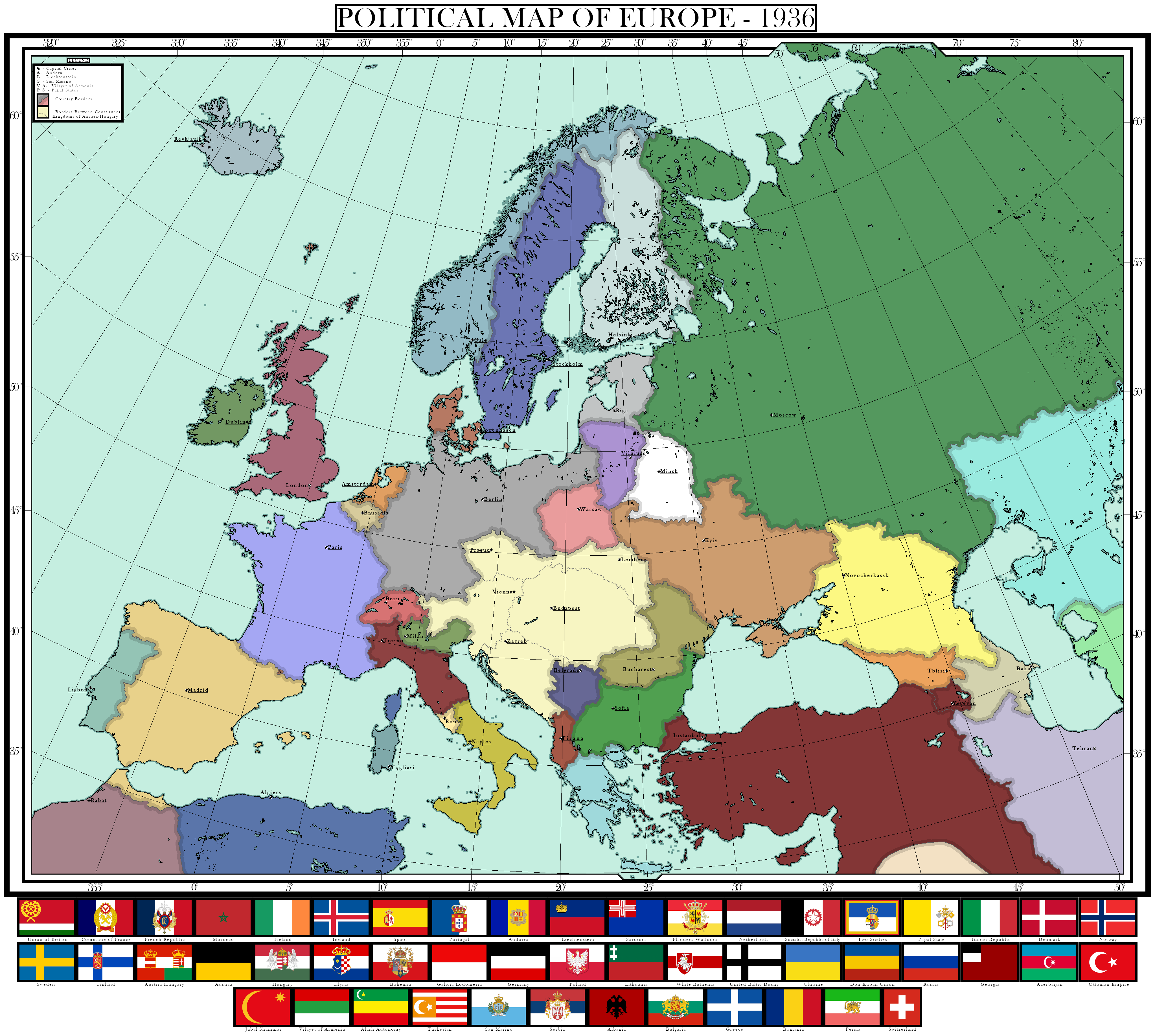
Political Map of Kaiserreich by DoctorSpaceIsTyping of r/kaiserreich
Kaiserreich tells the story of an alternate Second World War after a German victory in part 1. There have been books and endless video essays written about the world of Kaiserreich and I’m no expert but some of the major changes are an unstable and drastically weakened Russian Republic under Aleksandr Kerensky, a decolonised India, the survival of Qing China, a Second American Civil War and entrenched Syndicalist movements in the UK and France.
It seems once in a generation on PC, a mod gets so huge and so beloved that it takes on a life of its own, at the turn of the millennium that was Counter Strike, when I was a teenager that was Day Z and in recent years it’s been Kaiserreich, it’s not my sort of thing but super, super impressive to see.
The New Order: Last Days of Europe
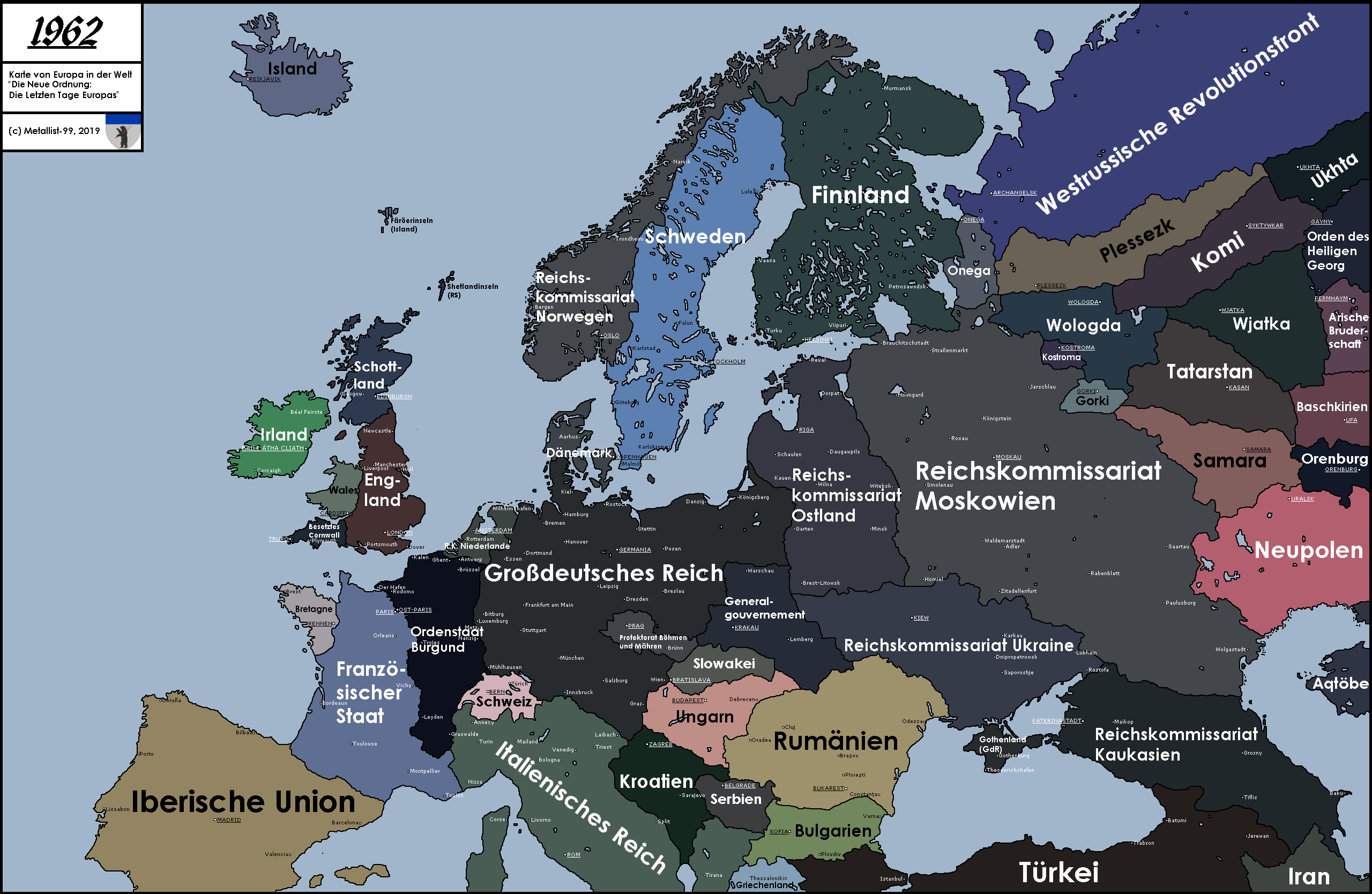
TNO is a Russian-centric mod that tasks the player with reuniting a post-apocalyptic Russia and taking the fight back to Germany almost 2 decades since their victory in World War 2 but there is plenty of content for some of the Axis powers too. This mod features a power struggle and civil war among the German inner circle, an absolutely esoteric set of political ideologies both real and imagined and a dark world shaped by the global dominance of Fascism and some of the Fascist powers’ wildest ideas coming to pass like draining the Adriatic Sea.
This is more of a narrative mod though, so prepare for lots of reading. I really love the setting but I don’t play HOI4 to read alt-history novels.
Millennium Dawn
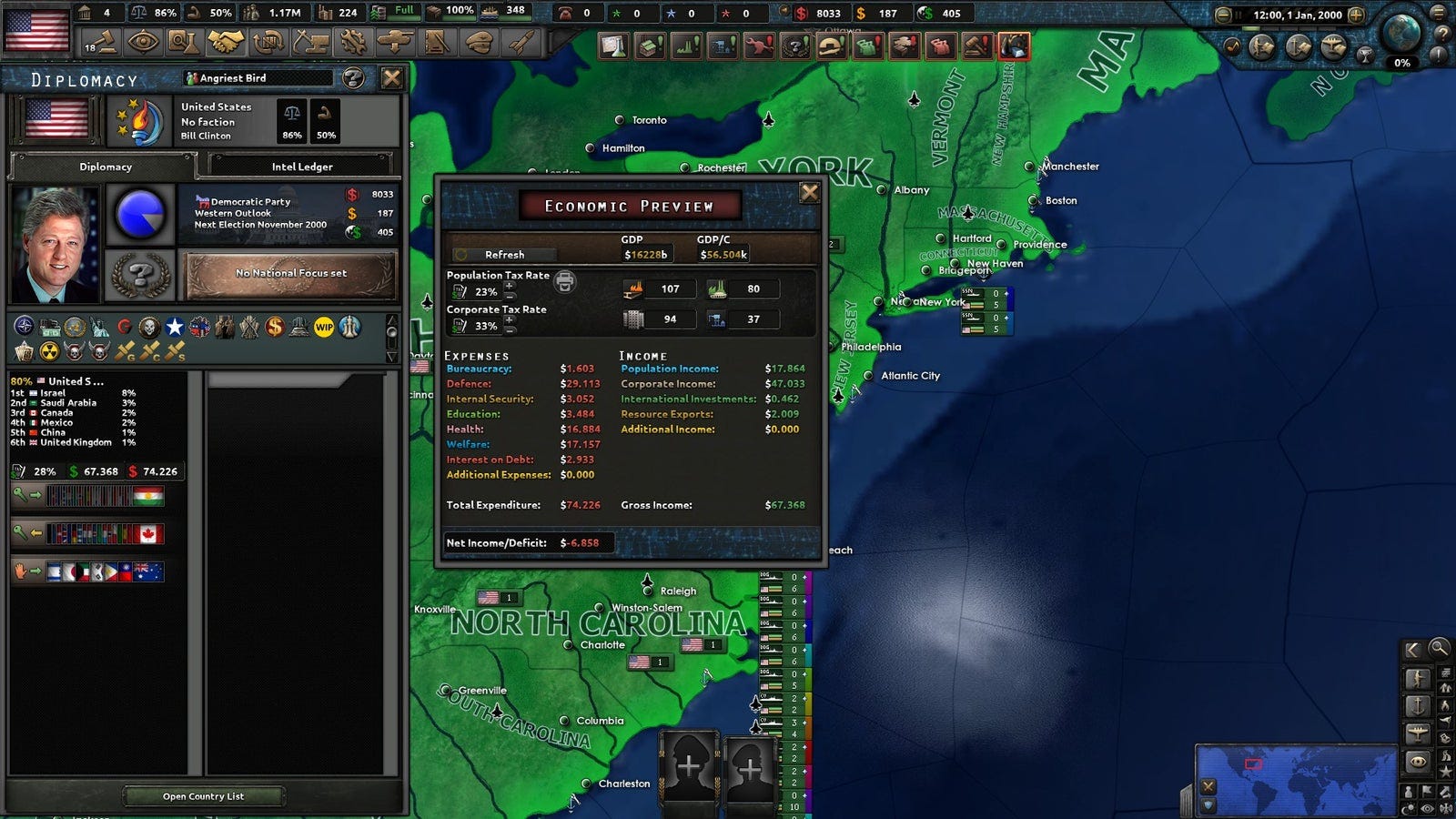
Millennium Dawn is Hearts of Iron 4 if it began in the year 2000, with plans further down the line to push that date back to 1991, this mod is economically focused with completely original systems for tax, foreign investment and debt but its focus trees do occasionally let you go to war too and there is plenty of alt-history to indulge in.
Want Ed Miliband as the PM? You can do that. Want Mitt Romney for President? Sure. Want to reform the USSR as Russian politician Gennady Zyuganov? Well, it’s your funeral pal. There is a surprising variety on offer here too, the mod team is annoyingly decentralised and openly berates people for asking when/if certain things are coming but I applaud their willingness to depict sensitive conflicts like in Palestine, Ukraine and Myanmar, though the team’s focus trees can sometimes be quite biased which has led to a few redesigns in the past.
I personally find this mod to be quite boring but if you use console commands and play certain nations it can still be a really good time.
Road to 56
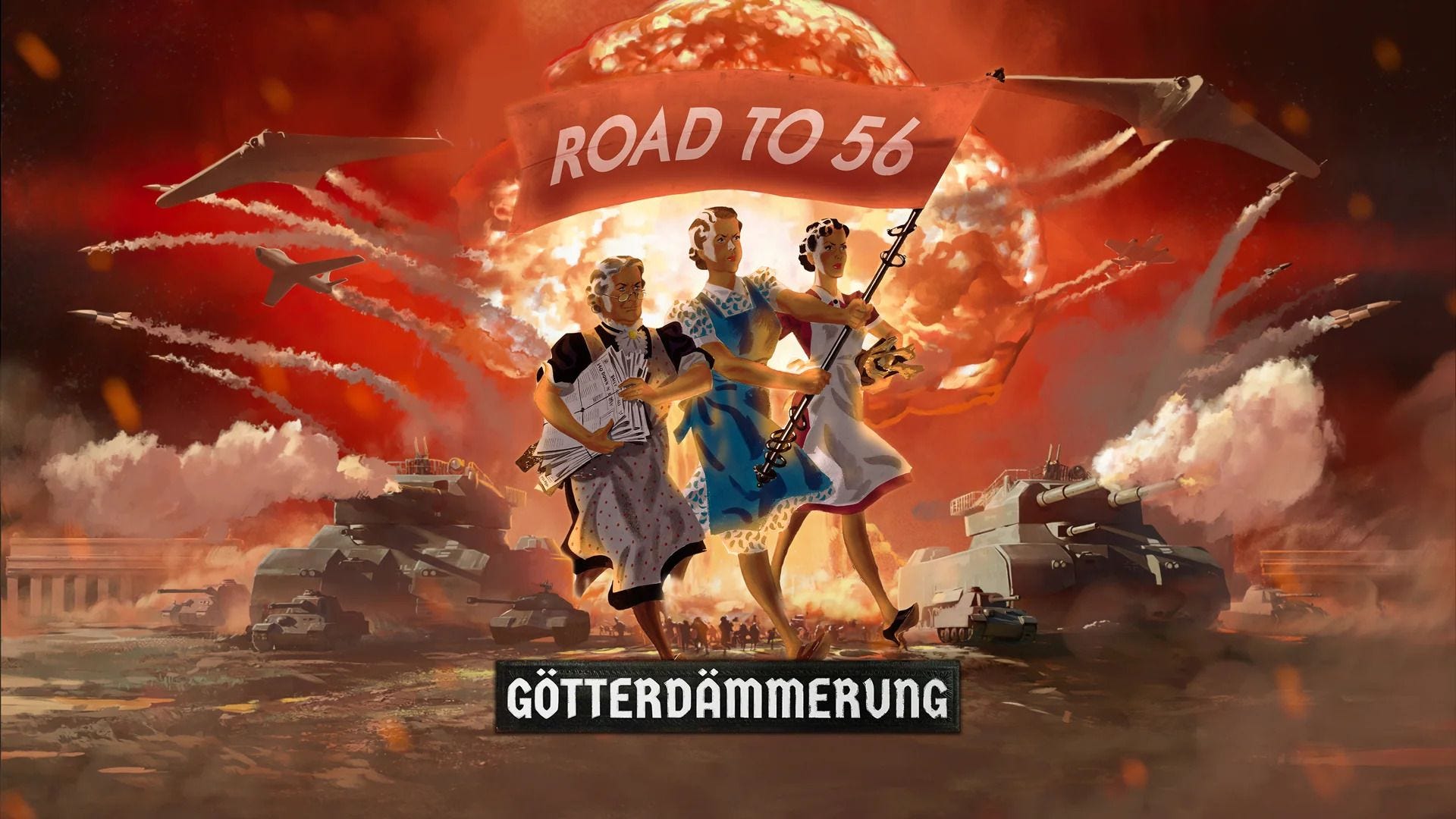
Road To 56 is my favourite Hearts of Iron 4 mod: I’ve probably played about 800 of my 2000 hours with it enabled and unless you’re an achievement hunter, a pretty big chunk of the community considers this mod a must-use while playing but it adds quite a lot and even includes features from Europa Universalis 4, so if you don’t know how to play then don’t get this mod yet.
Road To 56 is a huge overhaul and extension to the main game which extends the tech tree into the early Cold War, gives every player more research slots, expands the political system, makes the user interface and frontline tool much more easy on the eyes, adds a range of new focuses and even entire new focus trees for some of the neglected nations like French Indochina (Vietnam, Cambodia and Laos) and Siam (Thailand.) Before their big DLC overhauls, Road To 56 was really the only enjoyable way to play as the USSR or Italy.
You Love This Game? It Doesn’t Seem that Way
Some weeks ago now, I published a Note listing my 10 favourite video games ever and I placed Hearts of Iron 4 at number 10 on that list, to the shock of some of my readers.
But if I’ve been so critical of HOI4 in this review, then why?
Simply put, if you play any game for more than 2000 hours then you really see it for what it is: flaws and all and while I find Hearts of Iron 4 often frustrates me, especially when Paradox coughs up complete crap like the Graveyard of Empires DLC… nothing else hits quite like it. I love to hate and hate to love this game, even after weeks away, after swearing blind that I won’t touch it again, inevitably I fall back into the arms of Montgomery, Zhukov and MacArthur. It’s the first game I turn to when I have no idea what to play, it’s the only game where I will purchase DLC no questions asked because I know I will get my money’s worth eventually and despite the complexity, I don’t find Hearts of Iron 4 to be mentally draining to play like a lot of other complex strategy games; I applaud Steel Division 2 players, I love that game too but after 1 match I feel like I need a nap. Furthermore, Hearts of Iron 4 is the only game for me that achieves infinite replayability. After about the same amount of hours put into Crusader Kings 2 and 3, I find it very hard to want to play more of those games today because it feels like I’ve done everything there is to do (and because Crusader Kings 3 is painfully easy.)
More than my liking for Hearts of Iron 4, more than the individual parts that make up the whole, I think Paradox’s seminal WW2 conquestor is one of the most important video games of the 21st century.
Like basically every boring man ever born after 1945, I have been fascinated by World War 2 all my life. My next door neighbour growing up fought in Burma and I remember scowling that my parents wouldn’t let me listen to his stories or have them repeated to me, my school library had a decommissioned Second World War shell that I used to hold and imagine the route it had taken to me in the 21st century, I’ve walked the National Memorial Arboretum in Lichfield several times and like most people born in the Commonwealth or Europe, I know of a great grandparent who did his part for victory.
For decades, academics have written great tomes on the campaigns and generals of the war, tabletop wargamers have pushed counters around exquisitely detailed paper maps, Hollywood have dramatized the war’s many fronts and video games at last allowed players to experience a minute slither of what these young soldiers went through. Hearts of Iron 4 goes so far beyond what the rest of Second World War media is doing. When most games are too scared to implement a German campaign with an unambiguously pro-Nazi character and when most media doesn’t even depict the war outside of France in 1944, Hearts of Iron 4 not only depicts every single front of the war (this is still the only video game I’ve played that acknowledges the war in China) but it allows the player to utilise the very engines of state and drive the revanchism that were the seeds for the whole conflict and that is something very special; Hearts of Iron 4 makes the player feel like the hero: like the brave, stoic field marshal, even if they’re the villain who started the whole thing and that psychological element makes it all the more poignant.
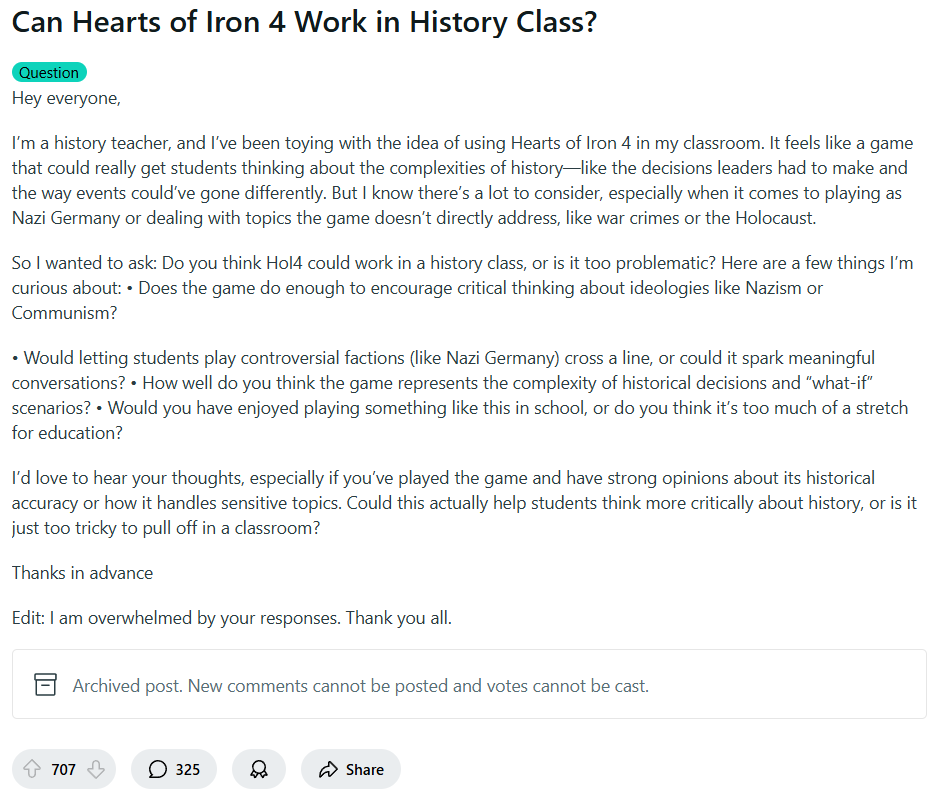
Hearts of Iron 4 has also transformed the way people are being educated about the Second World War and to my eye? It has been a net good able to dispel a lot of the myths and answer a lot of people’s questions about the war. It’s not a perfect tool but Hitler’s surge across Ukraine and Southern Russia makes a lot of sense when you realise in Hearts of Iron 4: just like in the real world, the oil fields of Baku were vital for the Red Army; the sense of weight an isolation upon the United Kingdom feels much more real when you see that Germany stretched from Spain to Lithuania after the fall of France and there are many more examples. I’ve even seen pictures online of University classes using screenshots from the game and professors hopping onto the forums or subreddit to ask questions about the game’s suitability for in-class use.
Hearts of Iron 4 is a cultural phenomenon, aside from being a seriously great video game.
The Verdict
Hearts of Iron 4 is replete with many minor blemishes, suffers from some long-standing bugs (fix the strategic redeploy button, Paradox) and is beginning to feel in need of a sequel; Hearts of Iron 4 is also my 10th favourite video game of all time, Paradox's magnum opus and a video game whose impact will still be felt decades from now, on a magnitude similar to the original Civilization which spawned the 4X genre, or of Command And Conquer which began the golden age of RTS games.
It’s long been said that strategy is a ‘dead genre’ which will never return to its 90’s heyday, especially with the Total War series seemingly on its deathbed but from my perspective? Hearts of Iron 4 is past its prime but still the greatest, Europa Universalis V is imminent and Crusader Kings 3 is about to double in size.
There has never been a better time for strategy games. Fighting games have made a triumphant return and so will us, stratey fans.
It's hard to enjoy these games once you break them apart and figure out how they play. They have zero simulation value. You can make a fairly good argument that "Rise and Fall of the Third Reich" by Prados from the 1970s was a pretty damn good simulation of WWII in Europe, with some indications as to what real impact variant events (Turkey joins the war, etc) might have had. HOI in any form isn't going to give you that.
I suppose it's all based on what you want. I happen to like simulations.
Been looking forward to this one, and it didn’t disappoint!
I already voiced some of my gripes in another discussion, and I can see where you share them. I hate the combat model and the trap options. The idea that all this complexity ultimately serves to pursue gamey strategies. HOI is way worse than CK and EU to me because the combat model is front and center. In those other games, victory mainly comes down to numbers and a few simple factors like leadership and tech.
Submarines were OP in Darkest Hour (HOI2 fork), and however many years later, they’re OP here too. At what point do they decide to just make subs a tool for commerce raiding?
I grew up playing Third Reich and later Adv. Third Reich with my dad, which are classic Avalon Hill board games. They had lots of hard rules to make sure the war followed a historic course. Adv. Third Reich mainly added a diplomacy system to allow some ahistoric but plausible things to happen.
It abstracted a lot of things that HOI4 models out in exquisite detail. E.g., fleets and air units just have a number. I’m sending 3 points of air support to back up this ground offensive. How many aircraft is that? How good are they? 3 points worth, that’s how much.
And what’s crazy is it modeled some things you’re saying HOI4 doesn’t. E.g. German control of Norway makes it easier to intercept Murmansk convoys. The risk of losing access to Swedish ore was modeled in the diplomacy of Adv. Third Reich.
The other thing that kills me in HOI4 is the lack of feedback. In Third Reich, you probably know TOO well why you lost a battle. There’s no fog of war. The probabilities are all in front of you. It’s always some obvious combination of bad dice rolls and insufficient force.
But in HOI4, which I played for maybe 100-200 hours (mainly in its first 2 years post-release), I never once knew why anything did or didn’t go my way. Did that enemy unit collapse mainly because I upgraded my artillery, because of some doctrine I pursued, my air support, or one of 1000 other things? How much did each of those help?
In Third Reich, I always knew how much my 3 points of air support helped: 3 points worth.
I know that HOI5 won’t dial up the abstraction to that level, but feedback is one of the biggest things I would wish for, that somehow respects the fog of war while still including intelligent analysis. I wonder if an LLM could be implemented to help assess things.
Just on history, one other thing I’ll touch on: the RAF really wasn’t that outnumbered (in terms of fighters at least) in the Battle of Britain. Especially by August 1940. It was outproducing the Germans in terms of fighters. I know you’re British and maybe there’s a British myth around playing up the numerical disadvantage.
The British also THOUGHT they were vastly outnumbered at the time; the size of the Luftwaffe was vastly overestimated following the collapse of France.
I recommend 3 books on the economics of WW2:
Why the Allies Won, by Overy
Wages of Destruction, by Tooze
How the War Was Won, by O’Brien